

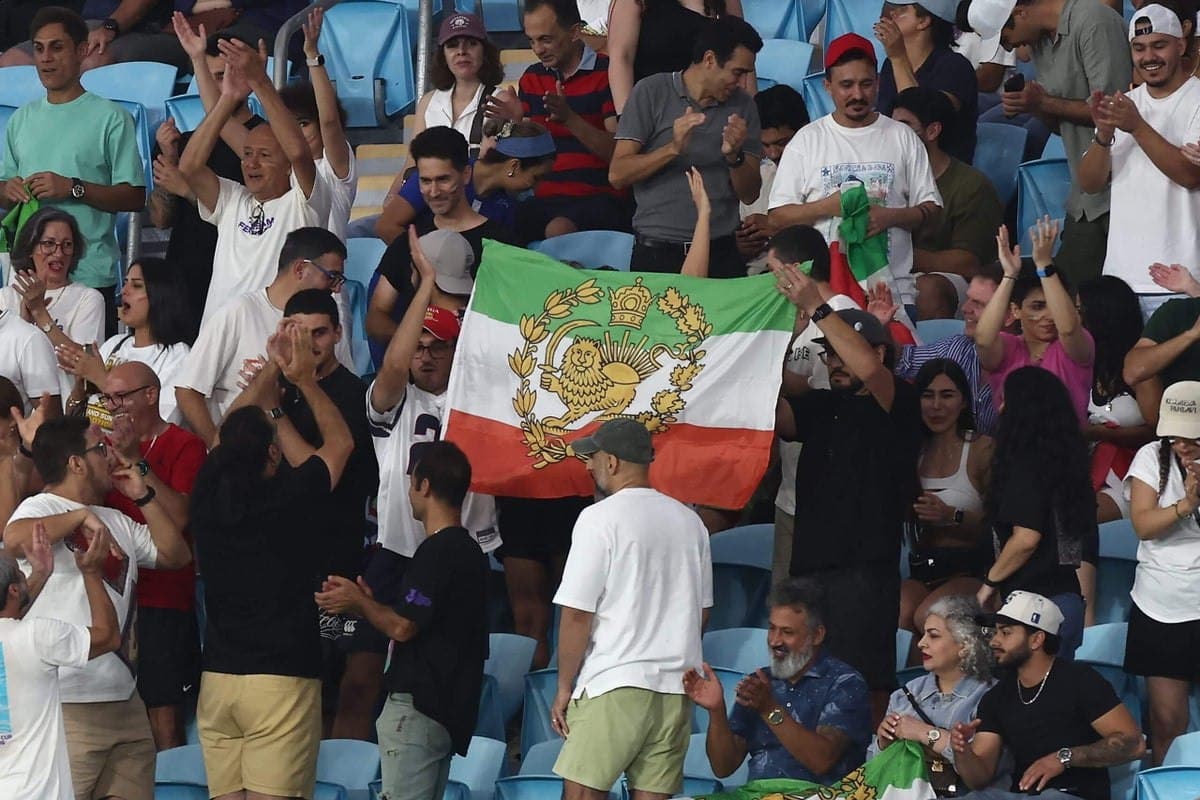
World Cup fans at Levi’s Stadium managed to bring in pre-revolutionary Iran flags, despite FIFA banning their presence at the tournament.
During the first half of Saturday’s game between Qatar and Switzerland, supporters unfurled multiple pre-revolutionary Iran flags — the country’s official flag until the 1979 revolution.
Both flags feature green, white, and red horizontal bands. However, while the current flag displays an Islamic emblem at its center, the pre-revolutionary version features a yellow lion and sun. The current flag also includes Arabic script along the borders of the green and red bands, reflecting Iran’s transition from a monarchy to a theocracy following the revolution.
The pre-revolutionary flag has been used by some members of the Iranian diaspora as a symbol of opposition to the current regime. It appeared at the 2022 FIFA World Cup and the 2024 AFC Asian Cup in Qatar, as well as at pro-Iranian demonstrations around the world following the outbreak of conflict involving Iran, Israel, and the United States.
At previous tournaments, some supporters were prevented from bringing the pre-revolutionary flag into stadiums. FIFA had reportedly planned to prohibit the flag again during this year’s World Cup in the United States, Mexico, and Canada. When asked about the policy, FIFA referred to its stadium code of conduct.
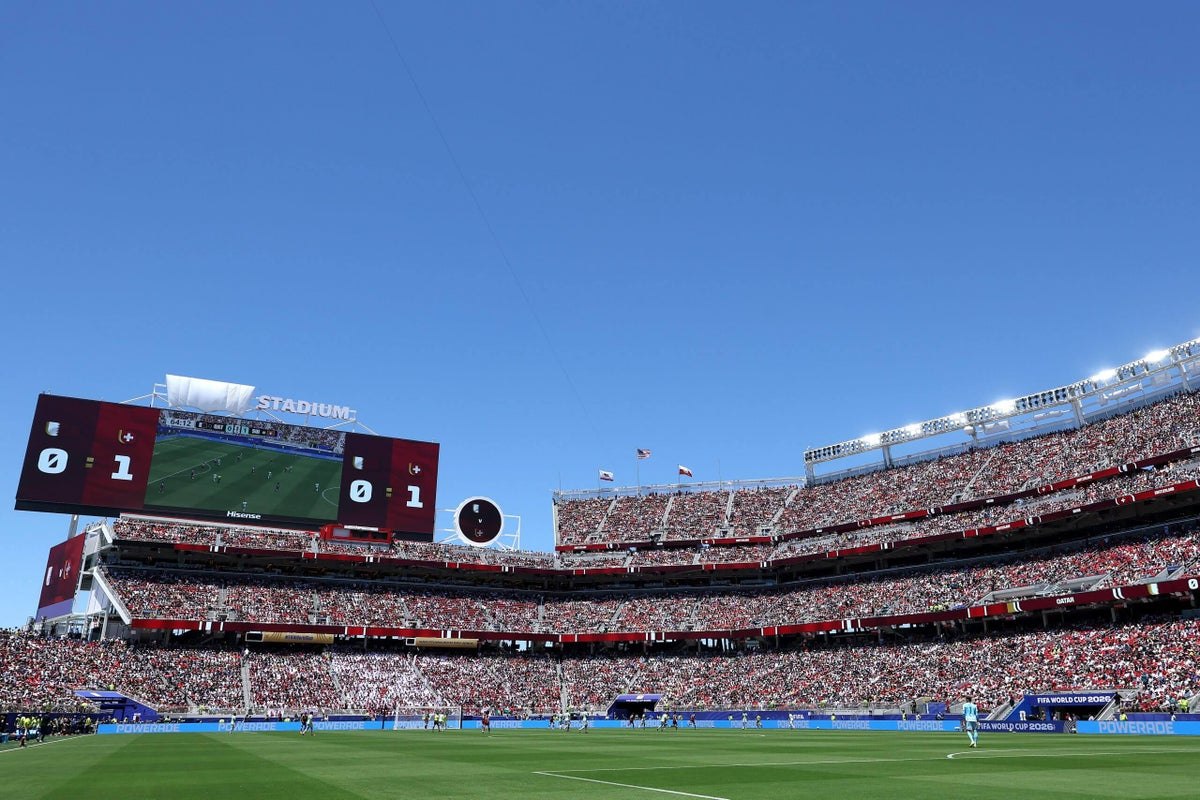
The code prohibits: “Any materials, including but not limited to banners, flags, fliers, apparel and other paraphernalia, that are of a political, offensive and/or discriminatory nature, containing wording, symbols or any other attributes aimed at discrimination of any kind against a country, private person or group on account of race, skin colour, ethnicity, national or social origin, gender identity and expression, disability, language, religion, political opinion or any other opinion, birth, wealth or any other status, sexual orientation or on any other grounds.”
Questions have been raised about how the pre-revolutionary Iranian flags were allowed into Levi’s Stadium. Requests for comment have been made to FIFA and the local host committee in the Bay Area.
Iran’s participation in the World Cup had been uncertain after the conflict began in February. However, the team arrived last week in Tijuana, Mexico, after plans to base the squad in Arizona were changed.
Iran has a large diaspora community on the west coast of the United States. The team’s arrival in Tijuana, located approximately 22 miles south of San Diego, was welcomed by a small group of supporters. Iran is scheduled to play its first two group-stage matches at SoFi Stadium in the Los Angeles area, with its third match taking place at Lumen Field in Seattle.
Earlier this week, a lawsuit was filed in California against FIFA regarding the ban on the pre-revolutionary Iranian flag at World Cup venues. The Institute for Voices of Liberty, a California-based nonprofit organization, argued that displaying the flag constitutes protected symbolic and political expression.
According to previous reporting, FIFA considers the pre-revolutionary flag to be political in nature. Sources familiar with FIFA’s position have indicated that this classification is the basis for the restriction.
Ahead of the tournament, the Iranian Football Federation submitted a list of requests to FIFA to ensure its participation in the World Cup, including a demand for “respect for the Iranian flag.”