

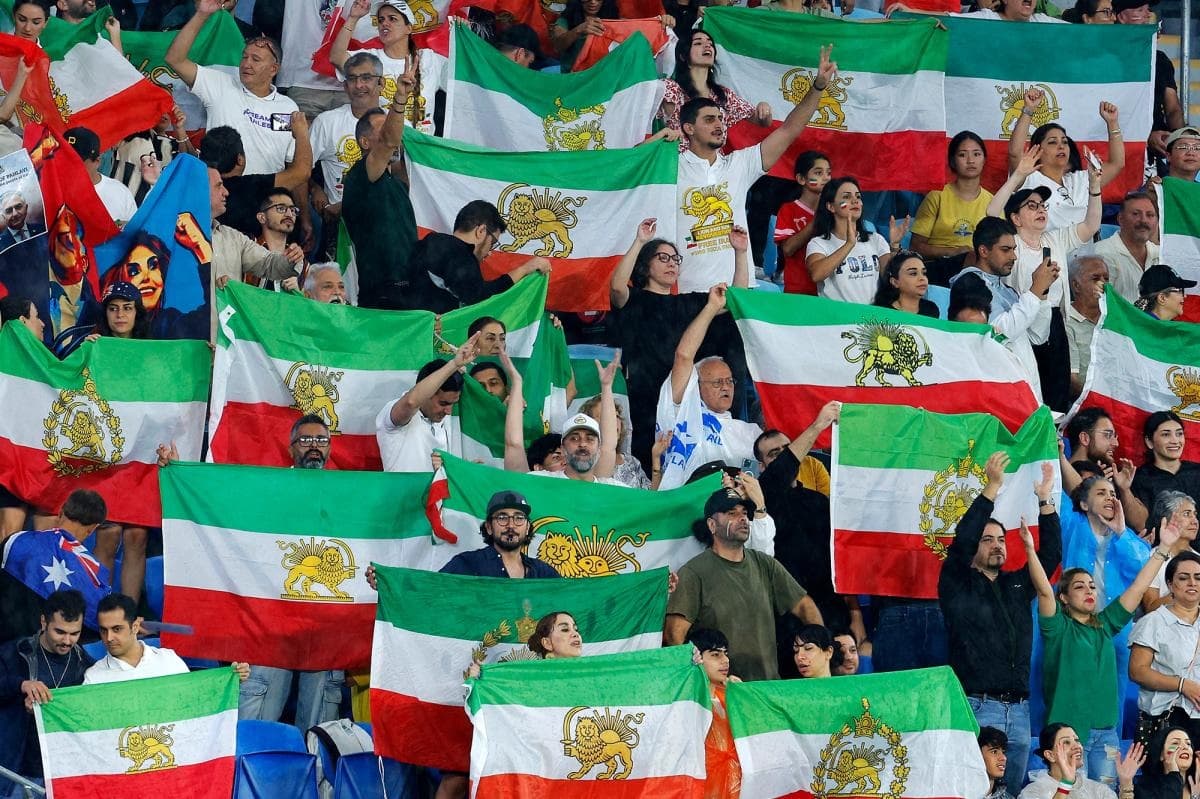
FIFA intends to once again prohibit fans from bringing flags and apparel to World Cup games which feature pre-revolutionary Iran symbolism.
The pre-revolutionary Iran flag is similar in color to the official national flag of the Islamic Republic of Iran. Both share in common red, white and green bands, but the pre-revolutionary flag also has a lion and the sun in the middle of its white band, while the official flag instead has an Islamic symbol and phrasing.
The flag was changed following the Iranian revolution in 1979, when the Islamic Republic emblem was placed onto the flag and affirmed the shift away from a monarchy to a theocratic government. The lion and sun, viewed as symbols of the previous Shah-led regime, were removed.
However, the pre-revolutionary flag has continued to be used by those in the Iranian diaspora as a symbol of identity and protest. At the World Cup in Qatar in 2022, many Iranian fans brought the country’s revolutionary flag to venues for the team’s games against England, Wales and the United States in the group stage of the competition.
However, upon arriving at the venues, some fans found they were not permitted to enter the stadium with either the flag, or visible messaging which was critical of the Iranian regime.
Qatar is a state that at the time enjoyed strong diplomatic relations with Iran, while in December 2017, the Iranian and Qatari football federations signed a memorandum of understanding to “strengthen the Qatari-Iranian relations.” The timing of this solidarity was significant, coming just three months after Saudi Arabia, the UAE, Bahrain and Egypt cut ties with Qatar, accusing it of supporting terrorism — a claim Qatar strongly denied.
During the Qatar World Cup, there were also submissions to FIFA via its Human Rights Grievance Procedure, whereby female Iranian supporters reported their fears that Iranian state spotters were present at games monitoring those who were present and/or protesting. One complainant told The Athletic they saw a man in the stand with binoculars, focusing consistently on the crowd rather than the field, and another said they saw a man in a suit filming a group of women behind him, before moving to a different location to monitor other supporters.
The U.S. west coast is home to a large Iranian diaspora. Iran is due to play two games at SoFi Stadium near Los Angeles and one in Seattle during the group stage of the World Cup.
Iran’s participation in the World Cup has been in question since the U.S. and Israel attacked Iran in late February, with conflict ongoing. However, tickets have sold well for Iran’s two games in LA, largely due to the strength of the diaspora in the region, which has even been affectionately coined “Tehrangeles”.
By April 10, as per figures seen by The Athletic, the fixture against New Zealand had already sold 50,661 tickets, which may also have excluded hospitality and member association allocations of sales.
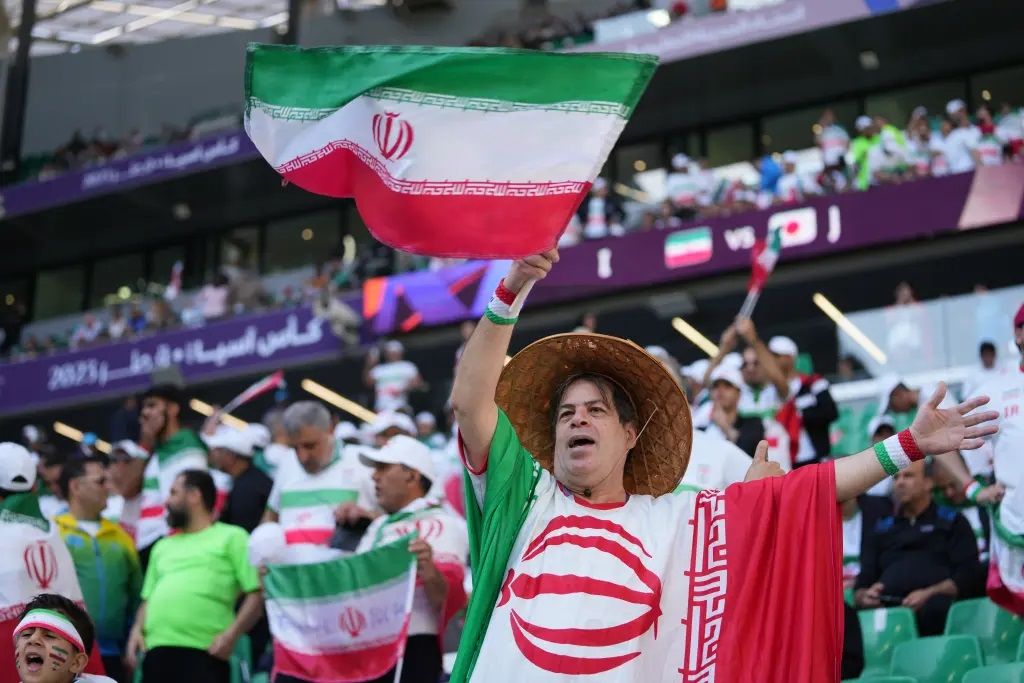
However, Iranians within the U.S. may have diverging opinions on the current government in Iran, with the pre-revolutionary flag often visible at gatherings and protests as a statement of identity.
According to a source with direct knowledge of FIFA’s planning, however, FIFA plans to prohibit the presence of the pre-revolutionary flag at its venues this summer. The Iranian Football Federation has previously issued FIFA with a list of demands for its attendance at the World Cup to be assured, which included “respect for the Iranian flag.”
Asked by The Athletic if FIFA will permit fans to bring flags (of appropriate size for security requirements) or wear apparel which bear the image of the pre-revolutionary flag, FIFA responded by sending its list of prohibited items from its stadium code of conduct.
Article 3.1.24 of the Stadium Code of Conduct states: “Any materials, including but not limited to banners, flags, fliers, apparel and other paraphernalia, that are of a political, offensive and/or discriminatory nature, containing wording, symbols or any other attributes aimed at discrimination of any kind against a country, private person or group on account of race, skin colour, ethnicity, national or social origin, gender identity and expression, disability, language, religion, political opinion or any other opinion, birth, wealth or any other status, sexual orientation or on any other grounds.”
It remains to be seen how vigilantly that stadium security staff will seek to police the matter when fans enter FIFA spaces this summer.
Karim Sadjadpour is a senior fellow at the Carnegie Endowment for International Peace, where he focuses on Iran and U.S. foreign policy toward the Middle East, and he said it would be risky for FIFA to attempt to restrict the visibility of the pre-revolutionary flag.
He said: “Trying to prohibit Iranians in LA from bringing the Lion and Sun flag into the stadium is like trying to prevent Americans from bringing the U.S. flag into an American stadium. It would cause mass unrest.
“World Cup matches best illustrate the passion Iranian-Americans feel for their homeland and the contempt they feel toward the Iranian government. Waving the Lion and Sun flag is simultaneously a show of support for the national team and a protest against the regime.”
The White House declined to comment on whether it has a view on the matter. The Department of Homeland Security said DHS “will work with our local and federal partners to secure 2026 FIFA World Cup — in line with federal law the U.S. Constitution — as we do with every major sporting event, while showcasing American greatness to the entire world.”
FIFA do, however, intend to permit fans to take the Palestine flag into their venues this summer. The difference between this and the pre-revolutionary Iran flag, from a FIFA perspective, is that the Palestine national flag is the officially approved flag of a member association of FIFA, and therefore it should only be removed from fans in the event it is deemed to represent a very serious security risk.